The Data Center Voice
Air Conditioning in the Data center Doesn't Create Cold. So What Does It Do?
Did you know that the air conditioning cooling a data center doesn't create cold at all? Air conditioning doesn't make cold air out of nothing.

Key takeaways
- Air conditioning doesn't make cold. It moves heat from inside to outside.
- Almost all the electricity used by IT equipment ends up as heat.
- Moving heat into hotter air takes energy, and the hotter the air, the more energy it takes.
- The outdoor unit rejects more heat than was removed from inside.
Did you know that the air conditioning cooling a data center doesn't create cold at all?
It's true. Air conditioning doesn't make cold air out of nothing. It simply takes heat from one place and moves it somewhere else.
The cold air you feel is just air that has had heat taken out of it. That heat didn't disappear; it was moved outside.
But how does that work? And how does it still work when the air outside is hotter than the air inside?
Where does the heat come from?
The servers in a data center draw electricity to run, and most of that electricity ends up as heat.
So if your IT equipment draws 100 kW, it adds roughly 100 kW of heat to the room:
100 kW IT Load ≈ 100 kW HeatNow picture a data center with thousands of servers running 24 hours a day, all year. All of that heat has to be removed continuously, or the equipment will overheat and shut down.
Keep in mind that heat from IT equipment is only where the calculation starts. There is also heat from lighting, from people, and from losses in electrical systems such as the UPS. The total heat load is always larger than the IT load.
Two principles that explain everything
The whole topic rests on two principles of thermodynamics.
First: the First Law of Thermodynamics
Energy is neither created nor destroyed.
Energy doesn't appear or vanish. It only changes from one form to another [1].
This explains why the electricity that goes into IT equipment comes out as heat. A processor doesn't store electricity. It uses it, and the energy leaves as heat.
Second: the Second Law of Thermodynamics
Heat cannot of itself pass from a colder to a hotter body. — Rudolf Clausius
On its own, heat only flows from hotter to colder. It never flows the other way by itself [2].
So to pull heat out of the room air, we need something colder than that air.
The key question
If the air outside is hotter than the temperature we want to keep inside… how do we get the heat out?
According to the Second Law, it won't leave on its own. We need something that forces it to flow against its natural direction.
The solution: the refrigeration cycle
This is where the refrigeration cycle comes in. In simple terms, it works like this [3]:
- Inside: the refrigerant flows through a coil called the evaporator. It's colder than the air, so it absorbs heat and evaporates.
- The compressor: compresses that vapor, raising its pressure and temperature until it's hotter than the outdoor air.
- Outside: a second coil, the condenser, releases the heat to the air. The refrigerant turns back into liquid, and the cycle repeats.
The trick is simple. We don't break the Second Law. We raise the refrigerant's temperature above the outdoor air, so the heat flows out of it naturally.
The compressor doesn't reject the heat. Its job is to raise the pressure and temperature. The rejection itself happens in the condenser.
And the whole process needs energy: the electricity that runs the compressor.
The outdoor unit rejects more than was removed inside
Go back to the First Law. The electricity the compressor uses doesn't disappear either. It becomes heat, and it joins the heat that was removed from inside.
So the condenser rejects both together:
Heat rejected outside = Heat removed inside + Compressor workCalculated example:
Assumption: a machine that moves 4 kW of heat for every 1 kW of electricity. That ratio is called the COP, and here it's 4.
Heat removed inside   = 100 kW

Compressor work       = 100 ÷ 4 = 25 kW

Heat rejected outside = 100 + 25 = 125 kW
In this example, the outdoor unit rejects a quarter more heat than was removed from inside. That's why heat-rejection equipment is sized for a larger load than the cooling load itself.
Why does hot weather make it harder?
The compressor has to raise the refrigerant's temperature above the outdoor air. So the hotter the air outside, the higher it has to raise it.
A bigger lift means more work. That means more electricity for the same amount of heat, and a lower COP.
This matters a lot in our region. According to the WMO, 2024 was the hottest year on record for the Arab region, and several countries recorded temperatures above 50°C [4].
So on the hardest summer days, cooling works harder and uses more energy.
Conclusion
When we talk about any data center cooling system, we're really talking about moving and rejecting heat. It isn't just air conditioning blowing out cold air.
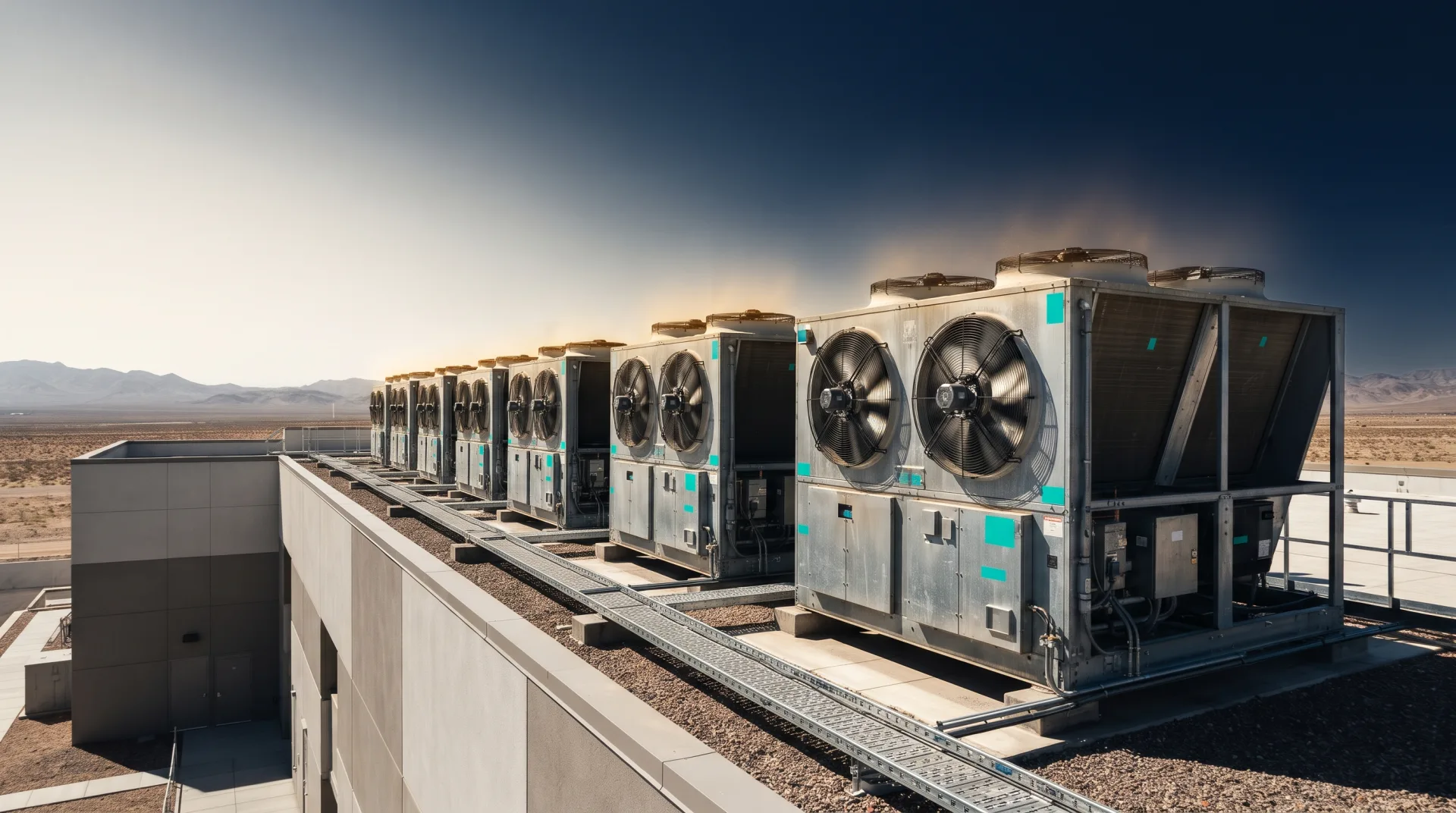
After this article, when you see cooling units on the roof of a data center, you'll know what they're doing. They're rejecting the heat from the equipment, plus the electricity we spent to reject it.
The numbers here are for understanding only. Designing a real cooling system takes a full heat load calculation, site climate data, and actual equipment specifications.
So how does the refrigerant absorb heat and reject it? What exactly happens inside it?
That's what we'll cover in the next article, when we explain the refrigeration cycle in detail.
References
[1] NASA Glenn Research Center — Conservation of Energy. https://www.grc.nasa.gov/www/K-12/airplane/thermo1f.html
[2] Encyclopædia Britannica — Rudolf Clausius. https://www.britannica.com/biography/Rudolf-Clausius
[3] U.S. Department of Energy — Energy Saver: Air Conditioning. https://www.energy.gov/node/1265606
[4] WMO — Temperature increase is accelerating in Arab Region, with escalating impacts (December 2025). https://wmo.int/news/media-centre/temperature-increase-accelerating-arab-region-escalating-impacts
Frequently asked questions
Where does the heat come from?
Why does hot weather make it harder?
What should you know about key takeaways?
What should you know about two principles that explain everything?
What should you know about the key question?
Subscribe to DC Talks
Get new articles and episodes by email. No spam, unsubscribe any time.
© 2026 Abobakr Alossaily | dctalks.com | All rights reserved